


Ambulatory infusion pumps
How to choose a used ambulatory infusion pump? A guide for healthcare professionals and veterinarians
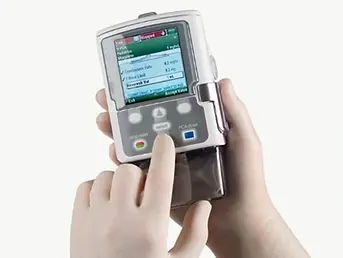
The ambulatory infusion pump allows for the controlled administration of medications or infusion solutions while facilitating patient mobility. Used in various healthcare settings, it can meet the needs of healthcare professionals, hospitals, home care services, and some veterinary clinics.
For professionals looking to control their budget, purchasing a used infusion pump can be an attractive option. However, it's essential to choose a model suited to the intended therapy, the necessary infusion parameters, and applicable safety requirements.
Atlantis Medical Systems offers several models of ambulatory pumps, including Micrel, CME, and CADD pumps. Here are the main criteria to consider to make an informed choice.
1. What is an ambulatory infusion pump?
An ambulatory infusion pump is a medical device designed to administer a liquid at a programmed rate, with a power supply and format allowing for mobile use depending on the model.
It can be used, in particular, within the framework of certain types of care:
continuous or intermittent infusions;
antibiotic therapy and certain prolonged treatments;
parenteral nutrition;
pain management;
patient-controlled analgesia, when the device and protocol are adapted;
home care or treatments requiring a certain degree of mobility.
However, not all ambulatory pumps meet the same needs. A pump intended for parenteral nutrition is not necessarily chosen according to the same criteria as a model intended for patient-controlled analgesia.
The choice should therefore be based on the clinical indication and the planned protocol, and not solely on the price or appearance of the device.
2. The essential criteria for choosing the right model
The type of treatment
This is the first criterion to consider. Some models are suitable for general infusions, while others have more specific functions for parenteral nutrition or bolus management.
It is particularly important to check the available administration methods: continuous flow, intermittent infusion, programmed bolus or patient-controlled bolus.
Programmable flow rates and volumes
Flow rate and volume ranges vary from model to model. It is essential to ensure that the device's capabilities meet the requirements and protocols under consideration.
The accuracy announced by the manufacturer is not sufficient on its own: the condition of the device, its maintenance, compatible consumables and conditions of use must also be taken into account.
Autonomy and mobility
For outpatient care, weight, bulk, transport system and autonomy are important factors.
A lightweight pump can make it easier to carry every day. However, it's essential to check the actual battery life under the intended usage conditions and the battery's condition, especially for a used device.
Alarms and security devices
Occlusion detection, end of infusion, battery level or compartment opening are among the functions that may be offered depending on the model.
The presence of these functions does not exempt you from checking their proper operation or following the manufacturer's instructions.
Accessories and consumables
Before purchasing, check the accessories included with the pump: battery, charger, bolus cable, stand or secure case, depending on the model.
The availability and compatibility of tubing, tanks, and other consumables must also be confirmed. A device offered at an attractive price may require additional accessories to be used under the intended conditions.
The models offered by Atlantis Medical Systems
The Atlantis Medical Systems catalog includes several families of ambulatory pumps. Availability fluctuates with sales and restocking; the product sheets remain the primary source for current stock levels.

Micrel Rythmic Plus
The Rythmic Plus is a compact ambulatory pump designed primarily for continuous infusions. The product sheet mentions programmable flow rates from 0.1 to 100 ml/h, several administration modes, and a claimed battery life of up to nine days at 2 ml/h, depending on the conditions specified.
It may be of interest to professionals looking for a portable pump for treatments suited to its characteristics.

This model is specifically presented as a patient-controlled analgesia pump for epidural administration. It features various delivery modes, including continuous flow and bolus, as well as a secure drug container depending on the configuration offered.
This is a model to consider when the need corresponds precisely to PCEA-type support and the associated protocol.

Micrel Mini Rythmic PN+
This compact model is specifically designed for ambulatory parenteral nutrition. The product sheet describes several infusion modes, an extended flow rate range, and safety and monitoring features.
It may be relevant for professionals seeking a pump suitable for parenteral nutrition, provided they check the protocol, accessories and consumables required.
Model referenced in the catalogue; availability to be confirmed.

Micrel Rhythmic Evolution
The Rythmic Evolution offers several administration modes, programmable parameters, and safety and monitoring features. Depending on the configuration, it can be designed for continuous infusion protocols and bolus management.
His choice should be based on the functions actually available on the proposed device, the configuration delivered and the processing requirements.

CME BodyGuard 575 Color Vision
The BodyGuard 575 is a portable volumetric pump designed for controlled administration, with programmable functions and alarms. The Atlantis product sheet mentions a flow rate range of 0.1 to 1200 ml/h, depending on the configuration and requirements.
It is an option to consider when the protocol requires a volumetric pump compatible with the intended use.

CADD Solis 2110
The CADD Solis is a programmable ambulatory infusion system that can manage, according to the configured protocol, continuous flow, intermittent boluses and patient-controlled boluses.
It may be of particular interest to organizations working on pain management protocols or other treatments adapted to the characteristics of the device.

CADD Legacy PCA
The CADD Legacy PCA is designed for patient-controlled analgesia protocols and can be programmed for continuous infusion, on-demand doses, or a combination of both, depending on the model's capabilities.
Its use requires appropriate prescription and supervision, as well as user training when necessary.
You can also find product families in the site's categories:
4. How to compare the models?
The following table can help guide an initial selection. It does not replace comparing the manuals and specifications of each device.
Model | Need to be examined as a priority | Point of vigilance |
Micrel Rythmic Plus | Continuous ambulatory infusion | Speeds, modes and accessories |
Micrel Rhythmic PCEA | Patient-controlled epidural analgesia | PCEA protocol and secure enclosure |
Micrel Mini Rythmic PN+ | Outpatient parenteral nutrition | Flow rates, consumables and battery life |
Micrel Rhythmic Evolution | Infusion with multiple programmable modes | Available configuration and functions |
CME BodyGuard 575 | Portable Volumetric Infusion | Compatibility with the protocol and consumables |
CADD Solis 2110 | Programmable infusion with bolus according to protocol | Programming and accessories |
CADD Legacy PCA | Patient-controlled analgesia | PCA settings, monitoring and training |
The Q-Core Sapphire pumps are also listed in the Atlantis Medical Systems catalog. Their versatility, color screen, and various administration modes may be appealing, but the product information sheet indicated they were unavailable. Therefore, it's best not to assume they are immediately available without prior verification.
5. Can a mobile pump be used for veterinary care?
Some models may be of interest to veterinary practices and clinics, particularly when they are looking for a portable or programmable infusion solution.
However, it is essential to verify that the device is suitable for the species involved, the treatment, the required flow rates, and the conditions of use. The characteristics of a pump intended for human use do not, in themselves, guarantee its suitability for every veterinary application.
The veterinarian must ensure that the model, its consumables and its parameters are suitable for the intended use.
6. Precautions to take before buying a used pump
Purchasing used medical equipment requires careful attention. Beyond the price, several factors deserve verification:
General condition: casing, screen, keyboard, battery compartment, connectors and mechanisms.
Accessories: the items listed in the product description are present.
Consumables: availability and compatibility of necessary tanks, tubing and accessories.
Note: availability of documentation corresponding exactly to the model and its version.
Configuration: language, programmable settings and options necessary for the intended use.
Technical verification: functional status, alarms, flow rate and other relevant checks before clinical use.
A used device may show signs of use or cosmetic damage. It is therefore important to read the description carefully and check the included items before ordering.
An important point regarding maintenance
Atlantis Medical Systems sells new or used medical equipment, but does not perform maintenance, pre-clinical technical verification or commissioning of devices.
Before any use on a patient or animal, the professional user must ensure that the equipment is suitable for the intended use and that the necessary checks, verifications and maintenance operations have been carried out by a competent operator, in accordance with applicable requirements, the manufacturer's instructions and the establishment's procedures.
For devices used in specific protocols, such as PCA or PCEA, programming, consumables, and user training are also essential points.
7. Why buy your ambulatory pump from Atlantis Medical Systems?
Atlantis Medical Systems offers a selection of new and used professional medical equipment, intended for healthcare professionals, midwives, veterinarians and specialist establishments in France and the European Union.
Buying second-hand equipment can help control investments, supplement an existing fleet, or search for a specific model at a lower cost than new equipment.
Our catalog is updated regularly to reflect the availability of new equipment. Professionals can consult the detailed product sheets to review the advertised specifications, included accessories, and stock availability.
Are you looking for a specific ambulatory infusion pump? Consult our dedicated category or product sheets to compare the available models.


Comments